Advanced Prosthodontics
The 90-Minute Bridge
The Shift to Additive 3D-Printed Restorations
1. Clinical Overview
The traditional “two-week” bridge—historically characterized by messy, gag-inducing putty impressions and highly fragile temporary plastic restorations—is now a relic of the past. Today, our clinic utilizes the SprintRay Digital Dentistry ecosystem to bypass remote laboratory wait times and the limitations of traditional milling.
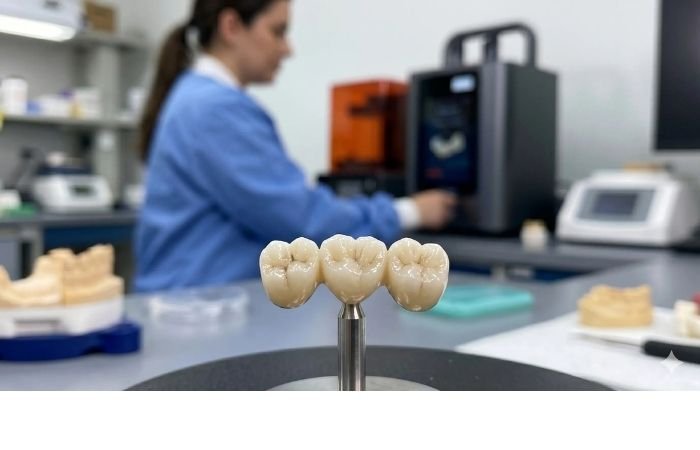
By leveraging the Shining 3D ELF ultra-high-definition intraoral scanner and SprintRay Midas automated 3D printing, we provide a definitive, ceramic-grade 3-unit bridge in approximately 90 minutes. This additive workflow represents the cutting edge of dental science; 3D printing allows for complex geometries and internal marginal fits that subtractive milling simply cannot replicate, resulting in a restoration with absolute, passive perfection.
2. The Procedure Protocol
Our highly streamlined, 90-minute workflow for a fixed 3-unit bridge is powered by high-speed additive manufacturing.
Automated Printing & Curing
The design is sent to the SprintRay Midas, the world’s first automated “Digital Casting” system. Unlike traditional mills that carve away material, Midas builds your bridge layer-by-layer with incredible micron-level accuracy. The system automatically washes, dries, and cures the restoration in one seamless cycle, delivering a lab-quality finish that is ready for immediate delivery.
3. Candidacy & Diagnostics
We utilize the Shining 3D high-precision diagnostics to ensure your supporting abutment teeth possess adequate bone level and are fully “load-bearing” ready before authorizing treatment.
Ideal Candidates
Patients missing a single tooth who possess healthy, structurally sound teeth on either side. This is the ultimate aesthetic upgrade for replacing old, failing PFM (porcelain-fused-to-metal) bridges that have developed an unsightly “black line” at the gingival margin.
Advanced Material Science
We exclusively utilize SprintRay Ceramic resin technologies. These monolithic 3D-printed ceramics offer a vital, natural translucency combined with the flexural strength needed for long-term bridge stability. Because they are 100% metal-free, your smile stays natural and vibrant over time.
4. The Extraction Bridge
Balancing Immediate Technology with Human Biology
While our SprintRay technology allows for the delivery of a high-quality bridge immediately following a surgical tooth extraction, it is critical to understand the profound biological journey your mouth begins the moment a tooth is removed.
The “Moving Foundation” Reality
Unlike a standard bridge placed on stable teeth, an extraction bridge sits over an actively healing socket. Over the next 3 to 6 months, your bone heals and gum tissue will naturally recede. Our digital workflow allows us to monitor this change with extreme precision.
The Aesthetic Result & Compromise
Because your new bridge is composed of high-grade 3D-printed ceramic, it is rigid and cannot “grow” with your gums. In the front of the mouth, we use the Midas system to create ultra-precise temporaries that protect your smile while the tissue matures, ensuring the final result looks perfectly seamless.
The DayOne Difference
We prioritize biological stabilization. Because our SprintRay restorations are 3D printed with the exact same precision as a final lab bridge, we provide a reliable, beautiful solution for the full duration of healing, avoiding long-term aesthetic disasters.
5. Recovery & Longevity
The longevity of our printed bridges is backed by SprintRay’s rigorous material testing and high flexural strength ratings.
By using Shining 3D ELF technology, we achieve a level of fit accuracy (down to 10 microns) that prevents the bacterial leakage responsible for bridge failure.
Because your definitive 3D-printed bridge is bonded immediately, the tooth is sealed instantly. You leave the office with your final smile, bypassing the sensitivity of a two-visit process.
6. Tech Specs: The SprintRay & Shining 3D Advantage
By bringing the Midas automated factory chairside, we deliver results that used to take weeks in a laboratory.
The SprintRay Midas uses advanced resin chemistry to create a dense, non-porous structure. This eliminates the “rocking” or micro-gaps common with analog cast metal or older milling tech.
Our printed materials are 100% metal-free and highly polished to repel plaque, promoting healthier gum tissue than traditional acrylic or metal-based bridges.
7. The Science of Adhesion
Why Our Bridges Don’t “Pop Off”
Success in digital dentistry relies on a meticulous Cementation Protocol. Our staff follows a strict, multi-step sequence to ensure your bridge stays permanently fused:
We roughen the internal surface of the 3D-printed ceramic to create a high-surface-area “grip” for the resin cement.
Using agents like Gluma®, we seal the living dentin to virtually eliminate any post-operative sensitivity.
We deploy advanced resin cements to chemically fuse the bridge directly to your natural tooth structure, establishing a permanent, hermetic seal.