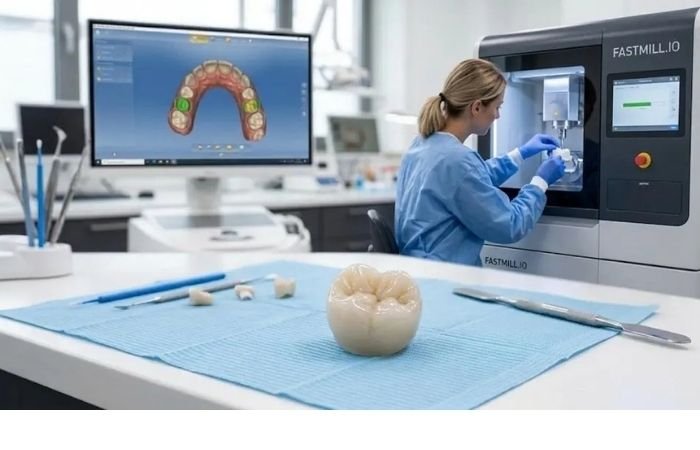
The 1-Hour Crown
The Shift to CAD/CAM Monolithic Restorations
1. Clinical Overview
A Paradigm Shift
The traditional “two-week” crown is rapidly becoming an artifact of the past. For decades, patients were forced to endure messy impression materials, wear fragile plastic temporaries, and return for a second injection of anesthesia weeks later. Today, our clinic utilizes the Shining 3D and SprintRay digital ecosystem to entirely bypass the physical impression and temporary crown phase.
By leveraging high-definition intraoral optical scanning and on-site additive manufacturing (3D printing), we provide a definitive, permanent lab-quality restoration in a single clinical appointment. This process isn’t just about speed or convenience; it’s fundamentally about the superior marginal fit, structural integrity, and biological seal achieved through uncompromising digital precision.
2. The Procedure Protocol
A Streamlined 60-Minute Workflow
Divided into two distinct, high-precision phases.
⚡ Phase 1: 15 Minutes
Digital Acquisition via Shining 3D ELF
Using the cutting-edge Shining 3D ELF optical scanner, we capture a flawless 3D digital “twin” of your dentition. This entirely eliminates the need for “goopy,” gag-inducing polyvinyl siloxane (PVS) impressions. The AI-powered software maps the topography of your mouth, identifying the “margin line” with a micron-level accuracy that traditional analog materials and human hands simply cannot replicate.
⚙️ Phase 2: 45 Minutes
Precision Fabrication via SprintRay Midas
Once the digital design is perfected chairside, the blueprint is transmitted directly to our SprintRay Midas in-office unit. This specialized digital “press” utilizes advanced additive technology to build your custom crown from a highly-filled ceramic resin. Because the system is optimized for the Midas workflow, the restoration possesses incredible anatomical detail and smoothness, ready to be seated immediately after a rapid curing cycle.
3. Candidacy & Diagnostics
Ensuring Structural Integrity
Diagnostic imaging is paramount to ensure the remaining tooth structure can support the 3D-printed ceramic restoration.
Patients requiring structural reinforcement due to fractured legacy amalgam fillings, recent root canal therapy, or significant carious lesions (decay).
We primarily utilize SprintRay Ceramic Crown resin, a FDA-cleared material with over 70% ceramic filler, designed to mimic the natural translucency and wear-resistance of human enamel.
4. Recovery & Longevity
High-Strength Clinical Science
Our success lies in the material science: specifically, the high-density polymerization and flexural strength of the Midas system.
🛡️ Unmatched Durability:
Unlike fragile bis-acryl temporaries, our 3D-printed ceramic restorations are engineered to withstand the intense forces of human mastication, providing long-term functional stability.
🚫 No “Second Numbing”:
Because the permanent restoration is bonded immediately, the dentin is sealed instantly, reporting vastly reduced post-operative sensitivity compared to traditional methods.
5. Technical Specs
The SprintRay & Shining 3D Advantage
We eliminate the traditional “Communication Gap” between the prescribing dentist and the lab by using a fully integrated digital workflow.
🎯 High-Fidelity Polymerization
Traditional impressions shrink. The SprintRay Midas system calculates exact volumetric accuracy so the crown fits with passive perfection on the very first try.
🌿 Advanced Biocompatibility
Our 3D-printed ceramic materials are 100% metal-free and biocompatible, polished to resist plaque and promote healthy, pink gingival tissue.
6. The Science of Adhesion
Why Our 1-Hour Crowns Don’t “Pop Off”
Many offices simply “glue” a crown and hope for the best; we adhere to a strict, multi-step biomimetic sequence to guarantee decades of retention.
🔗 Isolation & Fusion
We use elite resin cements formulated to chemically fuse the ceramic to your natural dentin, creating a hermetic seal against bacteria.
🌪️ Air Abrasion (Micro-Etching)
Before bonding, we micro-etch the crown interior with aluminum oxide. This creates millions of microscopic “hooks” for the cement to lock onto.
✨ Prophylactic Debridement
We mechanically scrub the tooth using non-fluoridated pumice to strip away the debris layer that actively interferes with the chemical bond.
🧘 Clinical Desensitization
We saturate the tooth with Gluma to permanently seal the microscopic nerve tunnels, ensuring your tooth feels perfectly natural and pain-free.
🧪 Chemical Decontamination
Saliva is the enemy of a bond. We deploy specialized cleaning agents to strip away phosphate proteins so the chemical bond is 100% pure.