Advanced Occlusal Therapy
Same-Day Fabrication
The Digital Evolution of the Nightguard
This comprehensive clinical report provides an in-depth technical overview of the advanced occlusal guard (nightguard) therapy actively provided at DayOne Dental. By leveraging the immense computational and manufacturing power of the in-house SprintRay Pro 2, we have entirely transitioned from antiquated, multi-week external laboratory workflows to a hyper-precision, same-day clinical protocol.
1. Clinical Overview: What is a Nightguard?
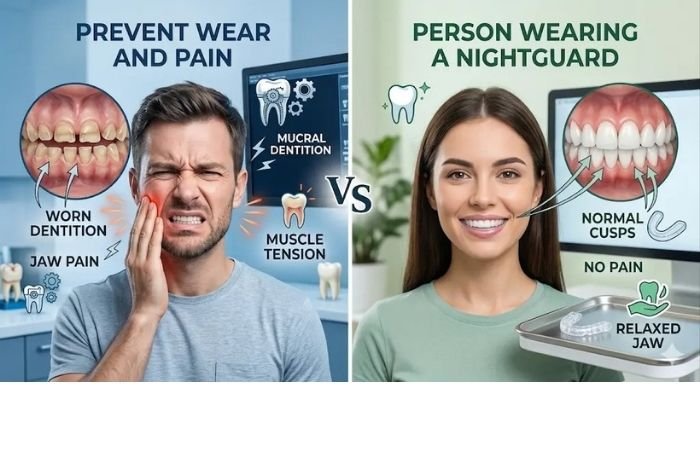
At its anatomical core, a nightguard—clinically referred to as an occlusal splint or orthotic device—is a removable, rigid or semi-rigid dental appliance meticulously designed to provide an impenetrable protective barrier between the maxillary (upper) and mandibular (lower) dental arches. While the general public often perceives it as a simple “piece of plastic,” it is, in reality, a highly calibrated biomechanical tool specifically engineered to manage and mitigate parafunctional bruxism (the severe, involuntary, and subconscious grinding or clenching of teeth during sleep cycles).
Human bite forces generated by the masseter muscles can easily exceed a staggering 200 pounds per square inch (PSI) during a nocturnal bruxism episode. When this occurs, massive kinetic forces are violently redirected into the teeth and jaw. Instead of the destructive enamel-on-enamel contact that leads to severe attrition (the physical shortening and flattening of teeth) and catastrophic micro-fractures, the custom nightguard safely absorbs, dissipates, and redistributes this kinetic energy across the entire arch.
By providing a highly specific, mathematically calculated thickness (increasing the Vertical Dimension of Occlusion), the guard acts as a physical wedge. This safely unloads and decompresses the Temporomandibular Joint (TMJ) space, drastically reducing articular disc inflammation and morning jaw pain.
The smooth, flat occlusal surface of the splint intentionally alters the proprioceptive sensory feedback sent to the brain. Because the teeth can no longer “lock” together in their habitual grooves, the brain is neurologically discouraged from engaging the masseter and temporalis muscles in high-intensity, destructive clenching.
2. The Procedure Protocol: How We Do It
Traditionally, acquiring a custom nightguard involved enduring “goopy,” gag-inducing alginate impressions and suffering a two-week wait while an outsourced laboratory in another state handled the fabrication. At DayOne Dental, we have forcefully compressed this entire ordeal into a single appointment using a fully digital, end-to-end chairside workflow.
We begin by deploying a high-definition intraoral optical scanner to instantaneously create a flawless 3D “digital twin” of your mouth. This advanced optics system captures the exact topography and undercuts of your teeth with a staggering precision of approximately 20 microns—exponentially more accurate than traditional poured stone models, which are prone to shrinkage and distortion.
Your high-res scans are instantly imported into specialized clinical dental software. Our team digitally designs the guard specifically to your anatomy, ensuring the “bite” (occlusal contacts) is mathematically balanced perfectly across all teeth. This exact balance prevents the dangerous “mesial shifting” or super-eruption of teeth that frequently occurs with soft, poorly fitted, over-the-counter “boil-and-bite” guards.
The finalized digital blueprint is transmitted to our 3D printer. This cutting-edge machine utilizes Digital Light Processing (DLP) technology. A high-intensity optical engine cures liquid photopolymer resin into a solid, high-strength, isotropic appliance layer by layer. The Pro 2 is specifically optimized for dental biocompatibility and ultra-rapid speed, allowing us to actively print a flawless guard in under 20 minutes.
Once printed, the raw guard undergoes a mandatory two-stage chemical solvent wash (isopropyl alcohol) to strip away any residual, uncured liquid resin. It is then subjected to a final, heat-controlled UV-light cure to permanently cross-link the polymers and reach its peak clinical flexural strength. We then perform a final chairside “try-in” to ensure the retention is comfortably snug and the occlusion is perfectly harmonious.
3. Candidacy & Diagnostics: Who Is It For?
Not every patient biologically requires a nightguard, but for those who exhibit signs of parafunction, it is definitively the most cost-effective and critical “insurance policy” for their smile. We strictly utilize several diagnostic clinical markers to determine candidacy:
Visible, highly polished flattening of the anterior canine tips or posterior molar cusps. This indicates severe, chronic enamel-to-enamel grinding during lateral jaw excursions.
Clinically known as Non-Carious Cervical Lesions, these are small, V-shaped notches at the gumline aggressively caused by teeth microscopically “flexing” and breaking off enamel prisms under immense occlusal pressure.
Consistently waking up with a dull temporal headache, a severely tight or “clicking” jaw, or generalized “sensitive” teeth that mysteriously dissipate as the day goes on and the muscles relax.
If you have heavily invested in aesthetic porcelain veneers, full-coverage crowns, or titanium dental implants, a nightguard is absolutely mandatory. Porcelain is stunningly beautiful but inherently brittle; an untreated clenching episode can easily fracture and destroy a multi-thousand-dollar restoration overnight.
4. Recovery & Longevity: What Happens After?
Your central nervous system requires approximately 7 to 10 nights to neurologically habituate to the presence of a new intraoral appliance. Initially, you may experience increased salivation (as the brain misinterprets the guard as food) or a slightly “tight” feeling in the morning. This is entirely normal as the proprioceptive periodontal ligaments actively adjust to the newly established resting posture.
A SprintRay Pro 2-printed DLP guard is incredibly durable, but it isn’t completely invincible. With diligent daily care, a high-quality 3D-printed guard typically maintains its structural integrity for 3 to 5 years.
5. Tech Specs: Materials & Engineering
At DayOne Dental, we absolutely refuse to use generic, porous vacuum-formed plastics. We exclusively utilize medical-grade, biocompatible photopolymer resins (specifically formulated by SprintRay for intraoral use).
Class IIa Biocompatible Photopolymer Resin
High-Impact Formulation
Mathematically engineered to be rigid enough for absolute occlusal protection, yet slightly flexible at body temperature for premium comfort and insertion.
Within 50 Microns of the Digital Scan
High-Clarity “SprintRay NightGuard” Clear Finish
100% BPA-Free and Monomer-Free (post-curing)
The SprintRay Pro 2 actively utilizes a proprietary Optical Engine with Bolt High-Speed Technology that ensures the curing light hits the liquid resin with perfect uniformity across the entire build platform. This eliminates the structural variations often found in conventional 3D printers, ensuring that the exact “fit” we verify on the CAD screen is precisely what is delivered into your mouth.
6. DayOne Dental’s Advantages
How We Excel: The Intersection of Expertise & Technology
Why choose our office for your mandatory occlusal therapy? It ultimately comes down to the seamless intersection of uncompromising clinical expertise and hyper-modern digital manufacturing.
There is absolutely no more wearing a poorly fitted “temporary” guard or waiting vulnerable weeks for an outsourced lab. You are scanned in the morning; you confidently pick up your fully cured, definitive guard in the afternoon.
If you accidentally lose your guard (or the dog tragically eats it), we do not need to subject you to new impressions. We permanently maintain your 3D STL file on a secure, HIPAA-compliant cloud server. We can simply hit “print” and have an exact replica ready for you within hours.
Because we maintain 100% control over the CAD design, we can micro-customize the “hardness” and “thickness” parameters based on your specific level of destructive bruxism. A muscular “heavy grinder” objectively requires a vastly different engineering profile than a stress-induced “light clencher.”
Our entirely digital workflow inherently allows for a significantly lower geometric profile (drastically less plastic bulk) while still maintaining superior flexural strength, making it exponentially easier for the patient to sleep deeply and comfortably through the night without airway obstruction.